Surbiton grew as a Victorian railway suburb of large villas, and many of those houses are now flats sharing drainage designed for one household.
The Victorian and Edwardian stock around the station and along the Ditton and Portsmouth roads is generously built, and generously built houses are exactly the ones that get converted. Two, three and four flats per building is common, with kitchens and bathrooms added over the years and connected into a soil stack that was never intended to receive them. The point where a later bathroom was joined in is often where a blockage forms, and clearing a shared stack from the wrong access can push waste into the flat below.
Beyond the Victorian core, Tolworth, Berrylands and Chessington are largely interwar and post-war estates on clay pipework, with the shrink-swell cracking that goes with heavy ground and the root ingress that goes with mature gardens. Thames Ditton and Long Ditton sit closer to the river and add a high water table to the mix, which produces drains that silt up through infiltration rather than blocking outright.
Several flats discharging into pipework sized for one household. Later connections are often where blockages form.
Tolworth, Berrylands and Chessington have a lot of interwar housing on clay. Dry summers can open joints, with blockages following later.
Closer to the Thames the water table can be high, and open joints let water in so the drain does not run clean.
This page covers Surbiton, Tolworth, Berrylands, Chessington, Hook, Thames Ditton and Long Ditton (KT5, KT6, KT9, KT7). If your postcode is on the edge of this area, call and ask rather than assuming.
Call and speak to the engineer. 24 hours a day, including tonight.
Sinks, toilets, gullies and main drains cleared, with the cause identified rather than guessed.
Overflowing gullies and blocked manholes or inspection chambers, cleared and explained.
Toilets that will not flush, or that fill up and will not drain, cleared without damaging the pan or the soil pipe.
Kitchen sinks and waste pipes blocked with grease, cleared properly rather than just poked through.
Standing water in the bath or shower tray, and slow bathroom basins, cleared at the cause.
Sewage backing up, drains overflowing, or a home or business you cannot use until it is fixed. Phone answered 24/7.
Scours grease, silt, scale and roots off the pipe wall, rather than just making a hole through the blockage.
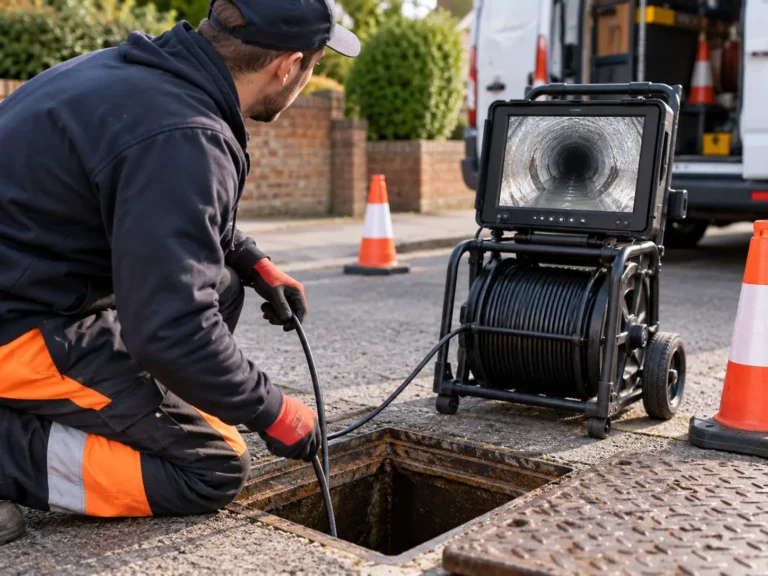
See the inside of the pipe: recurring blockages, pre-purchase checks, insurance and subsidence claims.
Cracked joints, root damage and collapsed sections, repaired without digging where the pipe allows.
Restaurants, pubs, offices, landlords and managing agents: planned maintenance and out-of-hours call-outs.
Leaks, taps, traps, toilet cisterns and waste pipes: the plumbing that often comes with a drainage job.
Common questions about drainage in Surbiton, answered for the kind of property you find there.
Usually the freeholder or managing agent, because the stack serves the whole building rather than any one flat. Your lease is what settles it. What we can do is establish exactly where the blockage was and which flats discharge above it, which is the evidence that decides who pays.

Probably not. It is a known pattern on clay soils. Clay shrinks in a dry spell and swells back through winter, and drainage laid in the 1930s gets flexed by that cycle every year. A long dry summer opens joints and cracks sections, and the blockages appear in the following months.
Call and speak to the engineer, 24 hours a day, including tonight.